





How Do Automatic Watches Work? A Mechanical Primer
A mechanical watch earns its place on the wrist through motion, not a battery. So, how do automatic watches work? With each natural movement of the wearer’s arm, a weighted rotor turns inside the case, winding a spring that stores energy and releases it in precisely measured increments. It is an elegantly contained system of physics, engineering, and patience.
For those drawn to intentional timepieces, the appeal is more than technical. An automatic watch makes its operation visible in the experience of ownership: the subtle resistance of a crown, the sweep of a seconds hand, the knowledge that a carefully made mechanism is keeping pace with daily life.
How Do Automatic Watches Work Inside the Case?
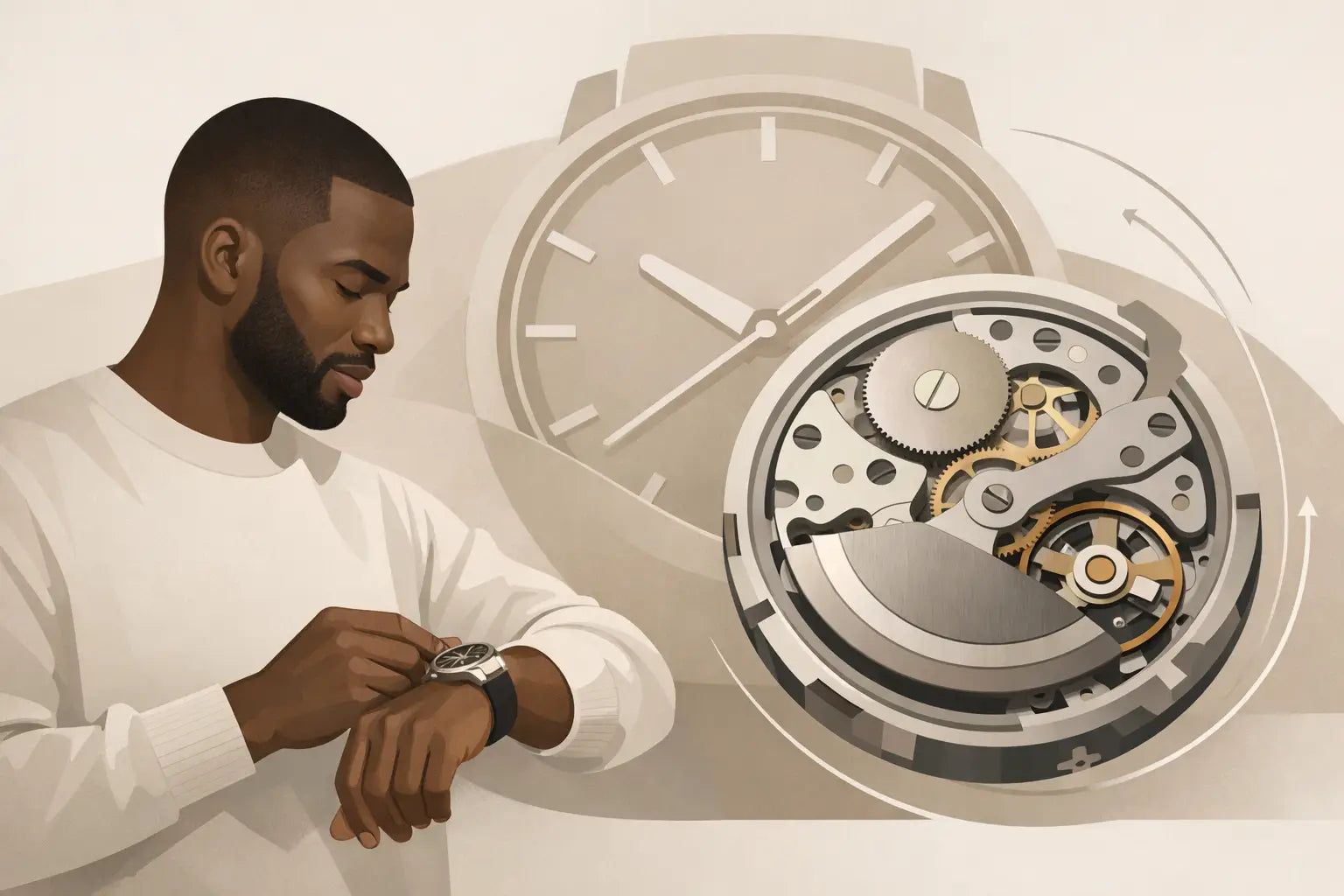
At the center of an automatic watch is a mechanical movement, a compact assembly of gears, springs, levers, and jewels. Unlike a quartz movement, which draws power from a battery and uses an electronic oscillator, a mechanical movement relies on stored physical energy.
The process begins with the rotor. This semicircular weight is mounted so it can rotate freely as the watch moves. Depending on the movement, it may wind in one direction or both. Its rotation passes through a set of reduction gears and winding components, transferring energy to the mainspring inside the barrel.
The mainspring is a long, thin strip of specialized metal coiled tightly within that barrel. As it winds, it accumulates tension. As it gradually unwinds, it turns the gear train, which carries energy through the movement toward the hands. The barrel is the watch’s reserve of potential energy, and its capacity determines, in large part, how long the watch can run after it is removed from the wrist.
A typical automatic movement offers a power reserve of roughly 38 to 72 hours, though some are designed to run longer. The number is useful, but it is not the whole story. A longer reserve can make a watch more forgiving when it is not worn for a day or two; a shorter reserve is often entirely practical for a piece worn regularly.
The Escapement Creates Order
If the mainspring simply released its energy without restraint, the hands would spin through the dial in seconds. The escapement prevents this. It releases the gear train’s energy in controlled, repeating pulses, while the balance wheel oscillates back and forth at a steady rate.
Think of the balance wheel as the movement’s timekeeping regulator. Its rhythm, set by a finely tuned hairspring, determines the pace at which the escapement allows the gears to advance. Every oscillation moves the watch forward by a small, measured amount.
This is why many mechanical watches appear to have a smoothly sweeping seconds hand. It is not truly continuous, but it advances several times per second rather than jumping once per second as many quartz watches do. The visual effect is quiet and fluid, but its importance is mechanical: each small movement is the expression of energy being metered through the escapement.
Why Jewels Matter
A watch movement’s listed jewel count refers to synthetic rubies placed at high-friction points, usually where pivots of tiny gears turn. These jewels are exceptionally hard, smooth, and resistant to wear. They reduce friction, help retain lubrication, and support consistency over years of use.
Jewels are not decorative stones placed inside the movement for effect. They are functional components with a long history in fine watchmaking. Their presence reflects a basic principle of enduring design: where friction cannot be eliminated, it should be intelligently managed.
Automatic Versus Manual Winding
An automatic watch is also a manual-wind watch in most cases. The crown can usually be turned to wind the mainspring directly, which is useful after the watch has stopped or when it has spent time off the wrist. The rotor simply adds a self-winding mechanism that replenishes energy during wear.
A manually wound watch has no rotor. Its slimmer movement can offer a more direct ritual, requiring the wearer to wind the crown regularly. An automatic watch adds convenience, though the rotor introduces a modest amount of thickness and movement complexity. Neither approach is inherently superior. It depends on whether one values daily interaction or prefers the watch to maintain itself through ordinary motion.
It is also worth understanding that movement is not the same as vigorous activity. An automatic watch does not need to be shaken to wind. In fact, this is unnecessary and potentially unkind to the mechanism. A normal day of walking, commuting, working, and gesturing is generally enough to support a properly functioning automatic movement. If the watch has stopped, a few turns of the crown, followed by regular wear, is the considered approach.
Accuracy Is a Matter of Mechanical Tolerance
Mechanical watches are not regulated like quartz instruments, and that distinction is part of their character. A quartz watch typically keeps time to within seconds per month. An automatic watch may gain or lose several seconds in a day, depending on its movement, adjustment, position, temperature, and state of wind.
This is not a flaw when understood in context. Mechanical timekeeping is an achievement of miniature engineering, but it remains physical. Lubricants change over time, gravity affects a watch differently in various resting positions, and shocks can influence regulation. Higher-grade movements are often adjusted more carefully and built to tighter standards, yet even they benefit from periodic attention.
For everyday ownership, consistency matters more than theoretical perfection. If a watch begins gaining or losing time noticeably beyond its established pattern, a watchmaker can assess its regulation and condition. The same measured perspective applies to water resistance. A watch rated for water exposure should still have its seals inspected over time, particularly if it is regularly worn near water.
What Keeps an Automatic Watch Running Well?
A well-made automatic watch is durable, but it is not indifferent to care. It is a small machine worn in an active environment, subject to magnetism, moisture, impact, skin oils, and changes in temperature. Thoughtful habits preserve both its function and its finish.
Avoid leaving a mechanical watch near powerful magnets, including some speakers, magnetic clasps, and electronic accessories. Magnetism can interfere with the hairspring and cause dramatic timekeeping errors. Modern movements may include anti-magnetic components, but sensible distance remains good practice.
When setting the watch, turn the hands forward whenever possible and avoid forcing the crown. If the watch includes a date display, do not adjust the date during the period when the mechanism may already be preparing to change it, commonly late in the evening through the early morning. The exact timing varies by movement, so the manufacturer’s guidance should lead.
Servicing is also part of ownership. Over several years, lubricants can dry or migrate, seals can age, and friction can increase. Service intervals depend on the movement, its use, and the maker’s recommendations, but a watch that is running well does not require unnecessary intervention. A qualified watchmaker should assess the movement when performance changes, water resistance needs renewal, or the service interval calls for it.
Storage deserves the same restraint. Keep the watch in a clean, dry place away from strong magnetic fields. A properly designed watch case protects it from dust, accidental knocks, and the abrasion that can occur when timepieces rest against one another. For a small collection, organized storage is less about display than preservation.
The Value of a Movement Made to Be Kept
An automatic watch is not valuable merely because it is complicated. Its lasting appeal comes from repairability, material discipline, and a design language that can outlive a season. A movement can be disassembled, cleaned, regulated, and returned to service. A case can develop an honest patina. A vegetable-tanned leather strap can soften and deepen with wear, then be replaced without diminishing the watch’s identity.
That longevity aligns naturally with quiet luxury. The most enduring objects do not need to announce their construction at a distance. Their quality reveals itself through proportion, finish, tactility, and dependable use. The same discernment that recognizes Japanese titanium or Italian Mazzucchelli acetate in a well-considered accessory can recognize the integrity of a mechanical caliber beneath a restrained dial.
In collections such as NCMPRBL Ascend Automatic, the movement is not simply a specification. It is the reason the object feels alive on the wrist. The rotor responds to the wearer, the mainspring carries that energy forward, and the balance wheel keeps its private rhythm beneath the dial.
An automatic watch asks for a little attention, then returns something increasingly rare: a daily object whose function is inseparable from its craft. Wear it often, maintain it well, and let its marks of use become part of a story worth keeping.