




How Minimalist Luxury Watches Earn Their Place
A watch can occupy less than two inches of wrist space and still say a great deal about its wearer. Minimalist luxury watches do so without relying on oversized cases, ornamental dials, or visible logos. Their appeal is more exacting: proportion, material, finish, and the quiet confidence of an object designed to remain relevant long after a season has passed.
For a professional whose wardrobe is built around strong tailoring, good denim, considered footwear, and a few dependable accessories, restraint is not an absence of personality. It is discernment. A well-made watch is a daily instrument, but it is also a record of taste. The best examples become familiar through wear, gaining character while holding their visual clarity.
What Defines Minimalist Luxury Watches
Minimalism in watch design is often misunderstood as plainness. A blank dial and a thin case are not enough. Luxury emerges from the decisions that are difficult to reduce: the curve where case meets lug, the depth of a handset, the resistance of a crown, the balance between polished and brushed surfaces, and the way a strap settles after months of wear.
A successful minimalist watch removes what does not serve the design. Its indexes are legible rather than decorative. Its date display, if present, is integrated with care. The dial offers enough negative space for the eye to rest. These choices leave no room for imprecision. On a crowded watch, a minor inconsistency can disappear among detail. On a restrained watch, it becomes the detail.
This is why proportion matters more than sheer diameter. A 40mm case may wear with distinction on one wrist and feel excessive on another, depending on lug-to-lug length, thickness, bezel width, and the architecture of the bracelet or strap. Many collectors are drawn to watches that sit close to the wrist and move easily from a morning meeting to dinner without demanding attention from either setting.
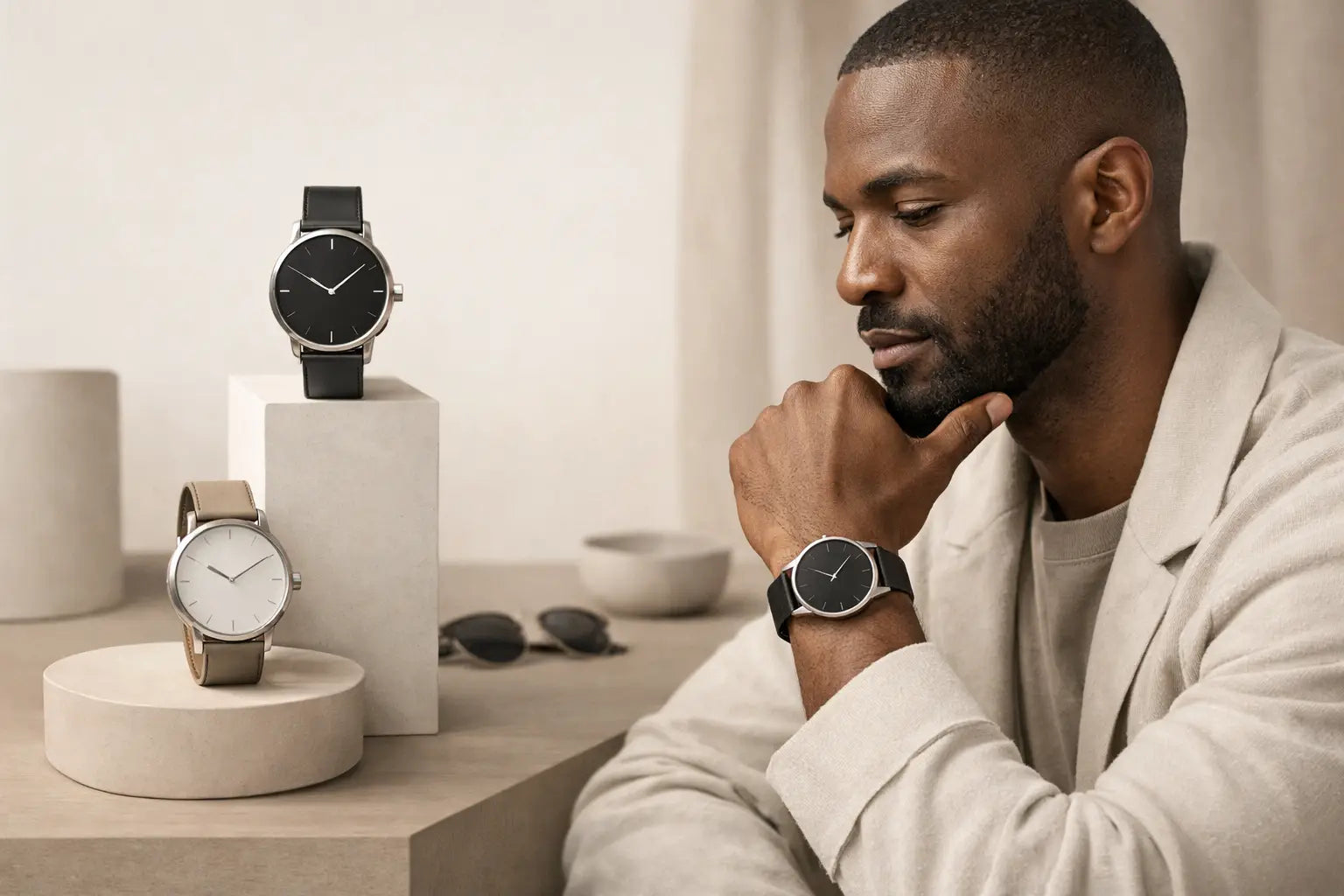
Quiet luxury has a practical side as well. A composed watch is easier to live with. It works under a cuff, beside knitwear, with a tuxedo, or with an open-collar shirt. Its versatility is not accidental. It comes from a refusal to make every occasion a performance.
Materials That Improve the Experience of Wear
The materials behind an intentional timepiece should be chosen for more than first impression. They determine how a watch feels at 8 a.m., how it responds to years of use, and whether it develops a convincing patina rather than simply showing fatigue.
Stainless steel remains a foundation for good reason. It is resilient, repairable, and capable of looking precise across different finishes. A brushed surface can lend architectural calm, while restrained polishing catches light without turning the watch into jewelry. The best steel cases feel substantial without becoming cumbersome.
Japanese titanium introduces a different register. Lighter than steel and notably comfortable in extended wear, it carries a technical refinement that suits minimalist design. Its subdued gray tone avoids the high-shine character of polished metal, making it particularly compelling for those who prefer an accessory that reads as considered rather than conspicuous. Titanium also asks for a degree of acceptance: it can show surface marks differently than steel, though many owners come to value that lived-in quality.
Leather contributes warmth and tactility. Vegetable-tanned leather, produced through a slower process using natural tannins, begins with structure and gradually softens to its wearer. It can deepen in color and show the evidence of use in a way synthetic materials cannot imitate. This is not maintenance-free elegance. Leather benefits from reasonable care and should be kept clear of prolonged moisture. In return, it becomes personal.
Sapphire crystal is another quiet marker of longevity. Its strong resistance to scratching helps preserve dial clarity, which matters especially when a design relies on open space and crisp details. Water resistance, meanwhile, should be viewed realistically. It is useful protection against ordinary daily exposure, but it is not a reason to treat every refined leather-strapped watch as aquatic equipment.
The Mechanical Case for an Automatic Watch
An automatic movement gives a minimalist watch a pulse. Powered by the motion of the wrist, it translates a system of springs, gears, and a weighted rotor into a steady progression of time. The appeal is not merely technical. It is emotional and physical: a small mechanical system working quietly beneath a clean dial.
Automatic watches ask something of their owners. They may need setting after time away from the wrist. Their accuracy is measured in seconds per day rather than through the near-perfect precision expected from a phone. They should be serviced periodically by qualified hands. For some, these are compromises. For others, they are exactly the point.
A mechanical watch creates a healthier relationship with utility. It does not pretend to replace every digital function. It offers a single purpose, performed with permanence and grace. The ritual of winding a crown, setting the time, and fastening a strap can be a welcome counterpoint to objects designed for constant alerts.
That said, the right choice depends on how one intends to wear it. An automatic model suits the person who values mechanical character and sees ownership as participation. A quartz movement may better suit someone who rotates watches infrequently or prefers low-maintenance precision. Minimalist luxury is not about choosing complexity for its own sake. It is about selecting the object whose qualities align with one’s actual life.
Why Restraint Makes Craftsmanship More Visible
A watch with fewer visual elements places greater pressure on every component. The spacing of indexes has to feel effortless. The dial finish must hold interest in changing light without becoming noisy. The hands need enough contrast for immediate reading, yet must not interrupt the composition. Even the typography on a dial can determine whether a design feels composed or merely sparse.
This is where the language of material heritage matters. A thoughtfully finished case, an automatic movement selected for reliability, and vegetable-tanned leather all carry histories of skilled production. They also offer a more durable basis for style than novelty-led details. Rather than chasing a new visual signal each season, the wearer develops a relationship with a small number of objects that perform consistently.
NCMPRBL approaches intentional timepieces through this lens: distinct collections, clear design direction, and pieces intended to live beyond a single wardrobe cycle. The strongest limited releases are not limited merely to create urgency. They are defined by a specific point of view, one that gives a collector a reason to return to the watch years later.
Choosing a Watch You Will Still Wear in Ten Years
The question is not whether a watch will match everything. Few objects should be asked to do that. The better question is whether it belongs naturally in the range of situations that define your life.
Start with the case. Consider the dimensions on your own wrist rather than treating size as a status signal. A watch should feel settled, with lugs that do not extend beyond the wrist and a profile that remains comfortable through a full day. Then consider the dial. Black, silver, deep blue, and warm neutral tones tend to provide the greatest range, but the right answer may be a color that reflects your existing wardrobe rather than a conventional rule.
A strap changes the character of a watch more than many buyers expect. Black leather is formal and precise. Brown leather introduces softness. A bracelet offers durability and a more architectural presence. If versatility matters, choose a case design that can accept different straps without losing its coherence.
Finally, consider the kind of value you mean when you call a watch an investment. Financial appreciation is uncertain and should never be assumed. The more dependable return is longevity: a piece made with materials worth maintaining, a design that avoids easy dating, and a daily companion that earns its place through repeated use. That is the foundation of a modern heirloom.
The most enduring watch is rarely the loudest one in the room. It is the one you reach for without deliberation, then notice again years later for how well it has accompanied the life you built around it.