




How to Store a Watch Collection With Care
A watch left on a nightstand tells a small story about its owner. A watch collection stored with care tells a longer one: of considered purchases, materials understood, and pieces intended to outlast a season. Knowing how to store watch collection pieces properly is less about creating a museum display than preserving the condition, accuracy, and character that made each timepiece worth choosing.
For a collection of automatic watches, refined dress pieces, and daily companions, storage should protect against the quiet threats: dust, abrupt temperature shifts, ultraviolet light, magnetism, excess moisture, and accidental contact between cases. The best arrangement is tailored to the watches themselves and to the rhythm in which you wear them.
Start With the Environment, Not the Box
A well-made case is valuable, but the room around it matters first. Watches are most comfortable in a stable, dry interior environment, away from windows, radiators, air vents, and the steam of a bathroom. Sudden changes in heat and humidity can stress lubricants and gaskets over time, particularly in vintage pieces or watches with unknown service histories.
Aim for a consistently temperate space with moderate humidity. A closet shelf, cabinet, or dresser drawer in a climate-controlled bedroom is generally more suitable than a windowsill, garage, or bedside surface exposed to daily light. Direct sun can fade leather straps, age certain dial finishes, and create unnecessary heat inside a closed case.
Magnetism deserves equal attention. Speakers, tablets with magnetic covers, wireless charging pads, and certain handbags with magnetic clasps should not share close quarters with mechanical watches. A magnetized movement may begin gaining or losing significant time. Modern watches often have some resistance, but sensible distance remains the more elegant precaution.
Choose Storage That Keeps Each Watch Separate
The essential principle is simple: no case should rest against another. Stainless steel is durable, but polished surfaces can collect fine marks. Sapphire crystals are highly scratch-resistant, yet bezels, bracelets, and clasps can still damage surrounding materials.
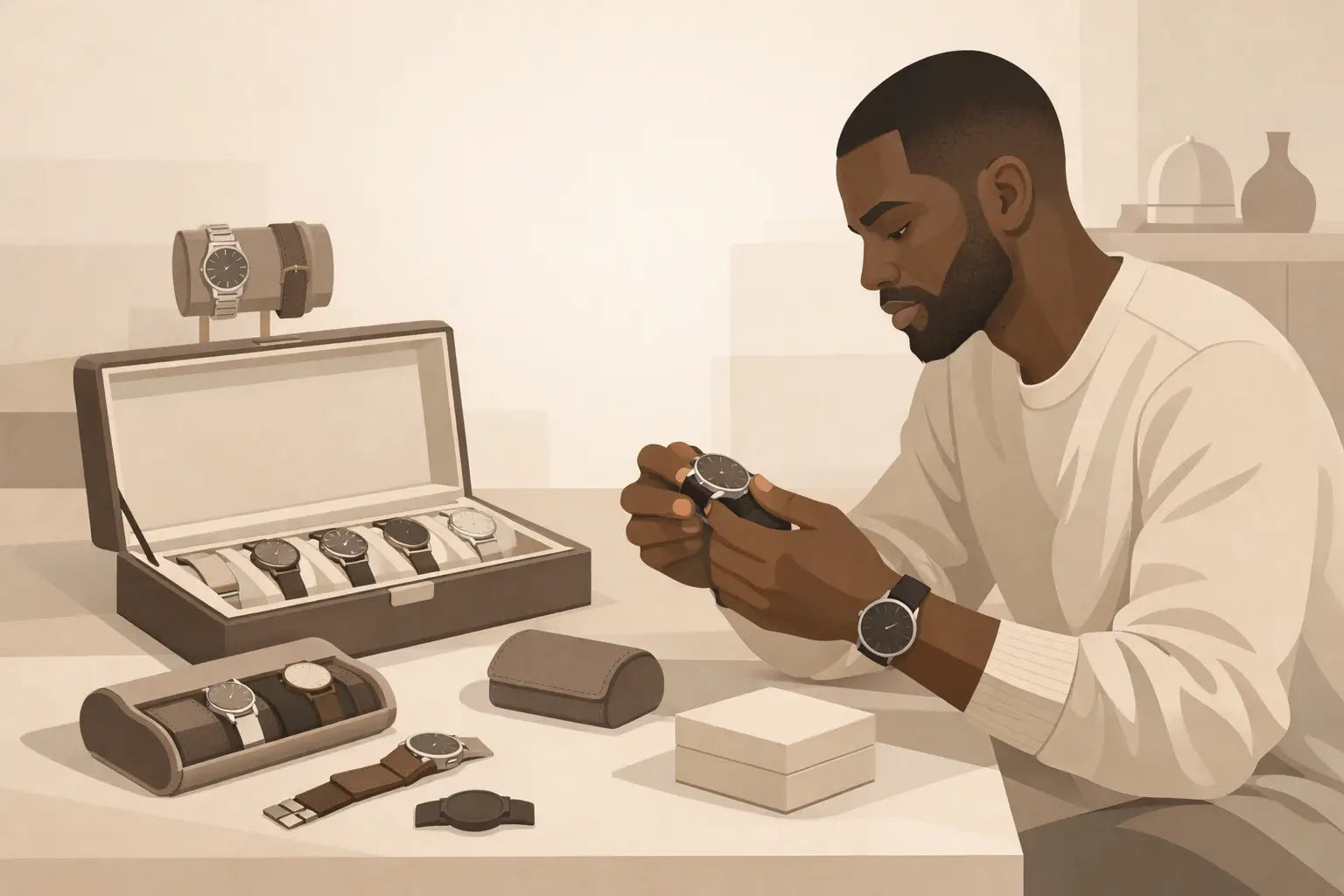
A dedicated watch box with individual cushions or compartments is the natural choice for a growing collection. Look for a rigid construction, a soft non-abrasive interior, secure hinges, and enough depth for the watches you actually own. Oversized divers, integrated-bracelet models, and thick automatic cases need more room than a slim dress watch. A compartment that compresses a strap or forces a bracelet into an unnatural curve is not a good fit.
For a smaller rotation, a leather watch roll provides a more compact answer. It is particularly useful for travel or for keeping a few frequently worn pieces organized in a drawer. Vegetable-tanned leather develops a richer surface over time, but it should be kept away from prolonged moisture and strong sunlight. The leather is part of the object, not merely its packaging.
Collectors who prefer a more deliberate home for their watches may choose a purpose-built format such as the NCMPRBL Elite Collectors Case. Its value is not simply visual order. Individual placement makes the morning selection easier while reducing the unnecessary handling that can lead to scratches, drops, or misplaced pieces.
Size the cushions correctly
A watch cushion should support the strap or bracelet without stretching it. If the cushion is too large, leather straps can develop stress at the holes and deployant clasps may sit under tension. If it is too small, the watch can slide around inside its compartment.
For bracelets, leave them loosely fastened around the cushion where possible. Avoid forcing a bracelet closed at its tightest setting. For leather, fabric, and rubber straps, use a gentle curve that resembles the shape they take on the wrist.
How to Store a Watch Collection by Movement Type
Not every watch has the same storage needs. Quartz, automatic, manual-wind, and vintage pieces each benefit from slightly different handling.
Quartz watches are straightforward, but they should not be forgotten indefinitely. If a battery is nearing the end of its life, have it replaced promptly rather than allowing it to leak inside the case. For watches stored over long periods, periodic checks are prudent. A stopped quartz watch is often only waiting for a new battery, but corrosion from a neglected one can be far more consequential.
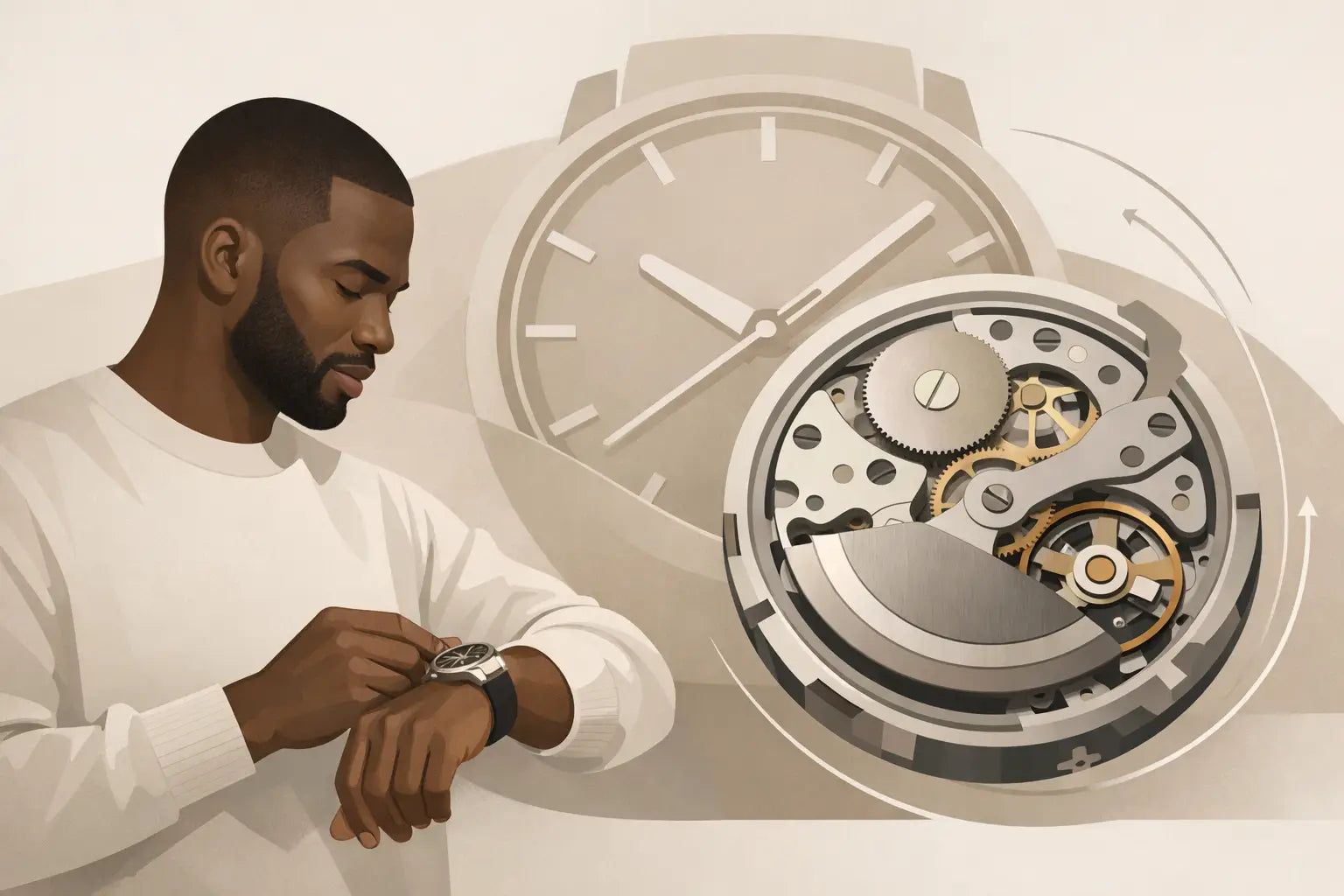
Automatic watches can be placed in a case once they have stopped, then wound and set when you are ready to wear them. This is often the simplest and most considered approach for a modest collection. A watch winder may be appropriate for a complicated automatic with a perpetual calendar, or for an owner who wears the same piece often enough to benefit from keeping it running. It is not a universal requirement.
If you use a winder, select one with programmable rotation direction and turns per day. The setting should match the manufacturer’s recommendations for the movement. More rotation is not inherently better; unnecessary winding can add wear over time. A quality automatic movement, such as one found in an intentional timepiece designed for regular use, is made to work. It does not need constant motion to prove it.
Manual-wind watches should be stored fully relaxed after use, not left tightly wound for months. Wind them only when you intend to wear them, using a measured touch. With vintage watches especially, a crown that resists should be assessed by a qualified watchmaker rather than forced.
Give vintage watches a separate standard
Vintage pieces deserve their own compartment, literally and figuratively. Their water resistance may no longer be reliable, even if the case was originally built for it. Original lume, lacquered dials, and aged leather straps can be more sensitive to light and humidity than modern materials.
Keep vintage watches away from silica packets that make a small enclosed container excessively dry, particularly if the watch has a delicate leather strap. Moderate conditions are the goal, not an artificially sterile environment. Service intervals should also be guided by the watchmaker who understands the movement, rather than a fixed rule applied to every era and reference.
Prepare Each Watch Before It Goes Away
A few seconds of care before storage preserve the finish more effectively than an occasional deep clean. Wipe the case and bracelet with a clean microfiber cloth to remove fingerprints, skin oils, and surface dust. Pay close attention to the underside of the case, clasp, and the spaces between bracelet links, where residue tends to collect.
For a watch worn in salt water, rinse according to its water-resistance rating before drying it. A properly sealed sports watch can be gently rinsed with fresh water after exposure to salt or chlorine, but a dress watch or vintage piece should never be treated on assumption alone. When in doubt, use a lightly damp cloth and keep water away from the crown and case openings.
Leather straps need a lighter hand. Do not saturate them with cleaning products or store them while damp. Let the strap dry naturally after a humid day, then return it to its cushion. This restraint preserves both the leather and the shape it acquires through wear.
Before placing a watch in its compartment, make sure the crown is fully pushed in or screwed down where applicable. Remove the watch carefully rather than pulling it by the strap, and never place it crystal-down on a hard surface during the process.
Build a Rotation That Makes the Collection Visible
The most useful watch storage system is one you will use. If part of the collection is hidden at the back of a drawer, it is more likely to be neglected, left with a depleted battery, or worn less than it deserves. A glass-top case can encourage rotation by making each piece visible. A closed cabinet offers more protection from light and dust. The right choice depends on the room and the character of the collection.
Consider arranging watches by use rather than strict value: daily pieces in the most accessible row, formal watches nearby, travel-ready models together, and less frequently worn or vintage watches in a more protected position. This gives the collection a practical logic. It also prevents the automatic reach for the same watch every morning.
Keep documentation, extra links, straps, and service records close by, though not loose inside the watch compartments. A labeled envelope or dedicated drawer maintains order without allowing metal parts to touch a case. For watches with particular provenance, notes on service dates and pressure testing can become part of the piece’s long-term record.
Inspect, Rotate, and Service With Intention
Storage is not a one-time task. Every few months, open the case and inspect the collection. Look for a stopped quartz movement, a dry or cracked strap, condensation under a crystal, or changes in timekeeping. These details are easier to address early than after years of neglect.
Rotate pieces according to how you live, not according to an arbitrary schedule. A restrained steel watch may serve a full workweek; a more expressive dial may belong to weekends and travel. The point is to let each watch earn the marks of a life well lived while protecting it from the damage of indifference.
A considered collection does not need constant handling or elaborate ceremony. It needs a stable place, clean surfaces, proper separation, and a habit of attention. Give every watch a place that respects its movement, materials, and future owner. That is how an object of personal style becomes an heirloom.