




Watch Storage That Respects the Collection
A watch left on a dresser is not merely waiting for tomorrow. It is exposed to dust, sunlight, accidental impact, and the small abrasions that gradually soften a case’s original clarity. Thoughtful watch storage is therefore part of collecting, not an afterthought to it. It preserves the object, but it also preserves the ritual: selecting a timepiece with the same consideration used to choose it in the first place.
For a single automatic worn daily, a protected resting place may be all that is required. For a growing rotation of intentional timepieces, storage becomes a matter of material compatibility, organization, security, and access. The right solution should make a collection feel composed rather than hidden away.
Why watch storage matters beyond protection
A well-made watch is built to accompany real life. Steel, sapphire crystal, leather, and carefully finished movements are durable materials, but durability is not immunity. A watch can withstand the occasional door frame or crowded commute better than many objects of similar scale. It should not, however, spend its off-hours rubbing against a bracelet, a set of keys, or another watch.
Most visible wear begins quietly. Fine scratches collect on polished surfaces. Dust settles into the spaces between bracelet links. Leather straps can take on uneven bends when left draped over a hard edge. None of this undermines the character of a well-worn piece, but there is a difference between a patina earned through use and damage created by neglect.
Storage also brings discipline to a rotation. When each watch has a defined place, it is easier to notice what receives regular wear, what needs a gentle cleaning, and what deserves more time on the wrist. A collection becomes legible. That matters whether it includes one automatic model and a trusted daily companion, or a selection built across years and limited releases.
Choosing a watch storage format
The most appropriate format depends less on the number of watches than on how they are worn. A person who alternates between two watches during the workweek has different needs from a collector who changes references with the season or travels often.
A single-watch case is a practical choice for travel and for timepieces that need their own protected environment. Look for a firm exterior, a lining that will not shed fibers, and a cushion sized to support the strap or bracelet without forcing it into a sharp curve. The case should close securely without putting pressure on the crystal or crown.
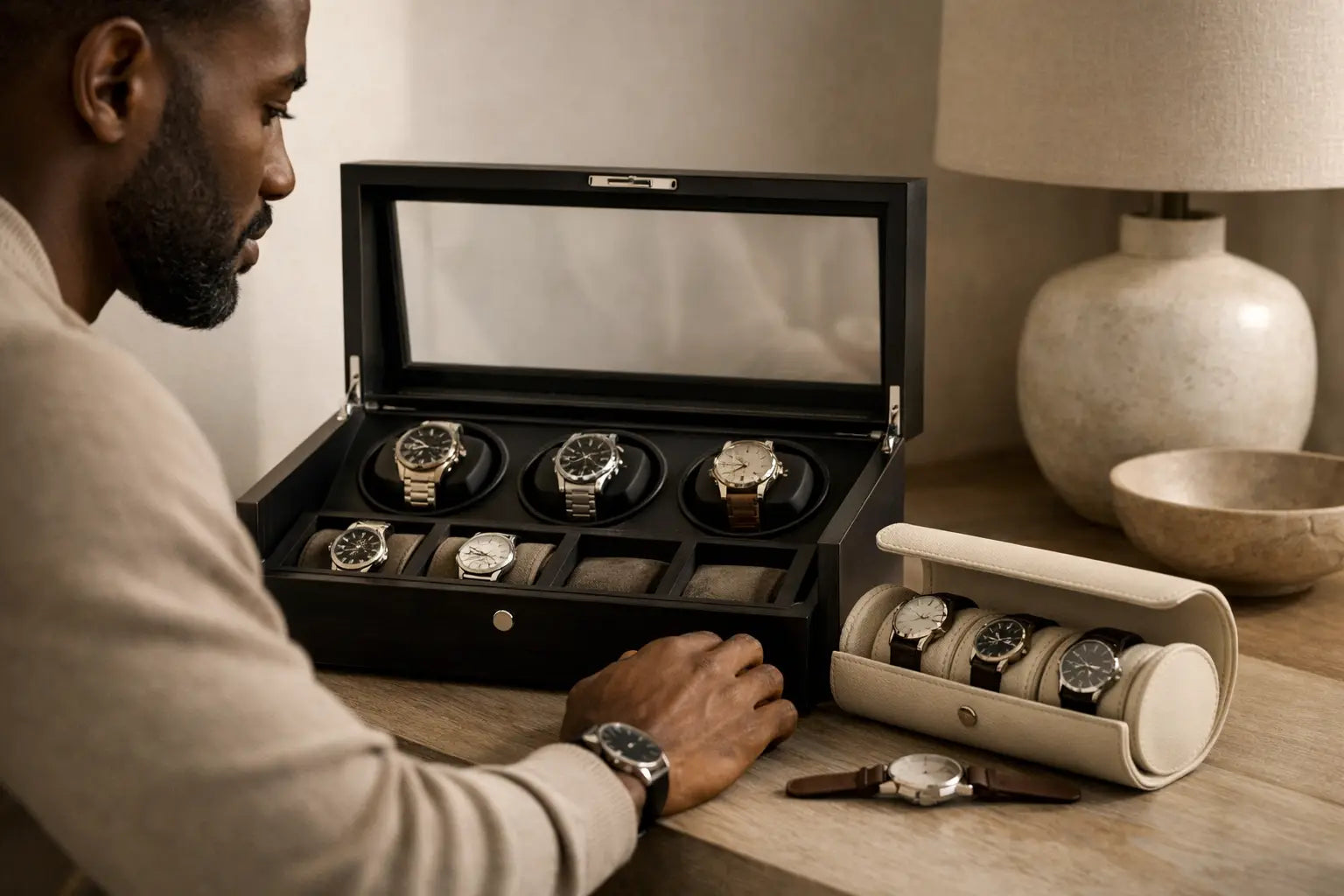
A watch roll has a more relaxed character and is especially useful for a small rotation on the move. Its advantage is compactness. Its compromise is structure: a soft roll offers less crush protection than a rigid case, so it is best carried within a larger bag rather than packed beneath heavier items. A properly made roll uses soft dividers to keep cases from contacting one another and a closure that remains reliable over time.
For a collection kept at home, a watch box or collectors case offers the clearest view and the most consistent organization. Individual compartments prevent contact between pieces, while a glass lid allows for easy selection without unnecessary handling. The NCMPRBL Elite Collectors Case reflects this collector-minded approach, giving intentional timepieces a considered setting between wears.
A winder serves a narrower purpose. It keeps certain automatic watches running by simulating wrist motion, which can be convenient for models with complicated calendars or for a piece worn in frequent rotation. But a winder is not inherently superior storage. Many automatic watches are perfectly well served by resting in a case and being reset when worn. The correct winding program also varies by movement, making restraint preferable to constant motion.
Materials reveal the quality of the case
The materials surrounding a watch should be chosen with nearly as much care as the materials in the watch itself. This is where a storage piece separates itself from a generic organizer.
Vegetable-tanned leather has a particular appeal for watch cases. It carries a natural depth, develops character with age, and can be made to a substantial, protective structure. Its surface will darken and soften with handling, which is part of its appeal. Quality leather should be finished cleanly at the edges and lined so that the watch does not rest directly against a coarse or unfinished interior.
The lining deserves close attention. Soft microfiber, suede, and fine textile linings help minimize incidental marks and prevent metal bracelets from shifting. The concern is not simply softness. A lining should be colorfast, low-shed, and securely fitted. Loose fibers and weak adhesive have no place around a polished caseback or a mechanical movement’s crown tube.
Wood cases can be beautiful, particularly when the grain and joinery are treated as part of the design rather than a decorative afterthought. They are best kept in a stable indoor environment, away from direct sunlight and dramatic changes in temperature. Leather and wood both reward measured care. Neither belongs near a radiator, on a humid bathroom counter, or in a sunlit window.
Fit is a technical detail, not a minor one
An undersized cushion can stretch a leather strap or place strain on a bracelet clasp. An oversized one can leave a watch loose enough to slide and knock against the compartment wall. The ideal cushion supports the watch in its natural closed position, with enough firmness to hold it steady and enough give to avoid forcing the strap.
This matters especially for watches with smaller case diameters, slim straps, or vintage-inspired proportions. A broad, stiff cushion may work for a large sports watch yet distort a more refined leather-strapped piece. If a case is meant to hold a mixed collection, adjustable or varied cushion sizes are worth seeking out.
Compartment dimensions deserve the same scrutiny. Watches should not touch when the lid is closed. A metal bracelet needs enough room to sit comfortably without pressing against the glass, while a tall automatic case requires sufficient depth. A beautifully finished box that crowds its contents is decorative furniture, not practical watch storage.
Care before a watch goes away
Storage works best when it follows a simple habit. Before returning a watch to its case, wipe the bracelet or case with a clean, dry microfiber cloth. This removes skin oils, fingerprints, and surface dust that can dull polished areas over time. For a leather strap, a light pass with a dry cloth is usually enough. Avoid applying conditioners casually, as excess product can darken leather or transfer to the lining.
If a watch has been exposed to saltwater, chlorinated water, sunscreen, or heavy perspiration, give it more attention before storing it. Provided its water resistance is appropriate and the crown is fully secured, a gentle fresh-water rinse followed by thorough drying can help remove residue. Leather straps should not be treated this way. Let them air dry naturally if damp, away from heat.
For longer periods of storage, keep the case in a cool, dry interior space with stable conditions. Extreme humidity can affect leather and adhesives; intense heat can accelerate material aging. Silica gel packets can be useful in a cabinet or safe where moisture is a concern, but they should not sit loose against the watches themselves.
Storage as part of a collecting practice
The best collections are not defined by quantity. They are defined by judgment: a reliable daily watch, an automatic chosen for its movement and proportion, a distinctive piece that marks a personal milestone. Storage should honor that logic. It need not turn a home into a vault or make every selection feel ceremonial. It should simply create order around objects made to last.
There is value in being able to open a case and see a small record of your taste taking shape. The restrained lines of a case, the warmth of vegetable-tanned leather, and the quiet precision of a movement at rest all support the same idea. Care is not separate from ownership. It is one of the ways a timepiece becomes worth passing on.