





How to Measure Lug Width for a Better Fit
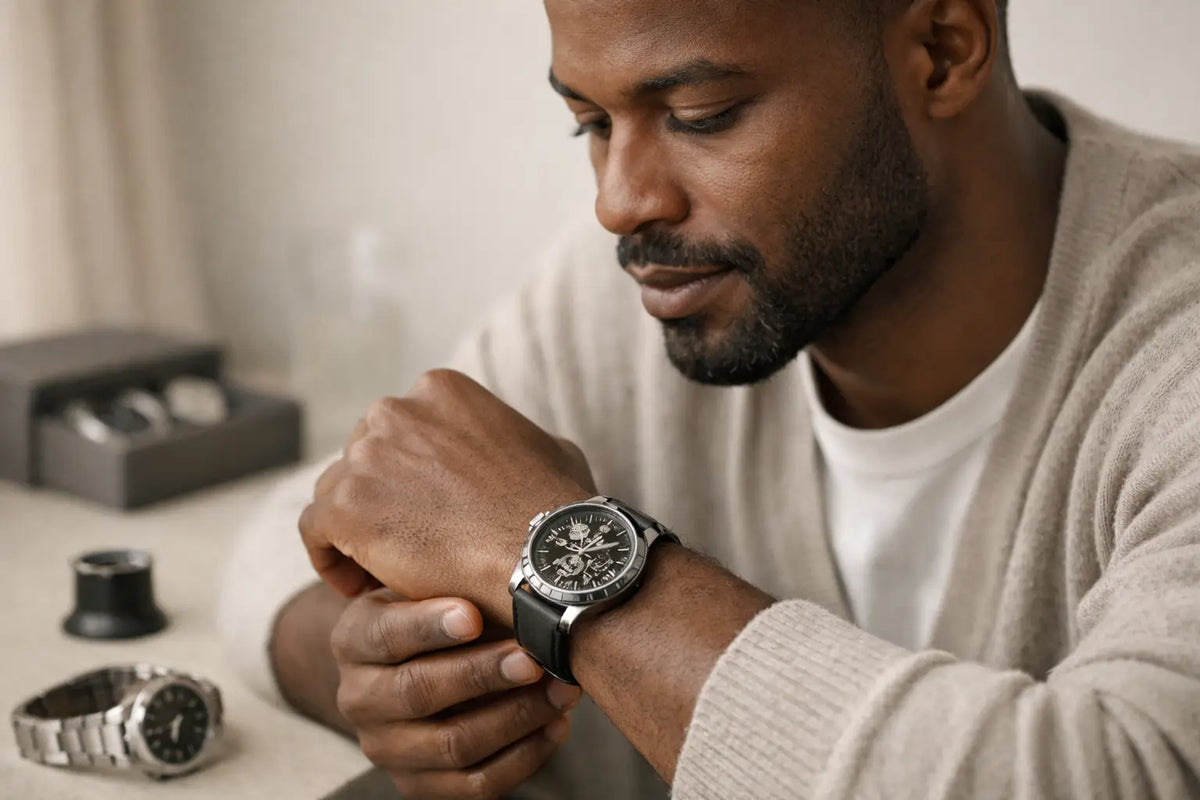
A well-chosen strap can make a familiar watch feel newly considered. But before leather, rubber, or woven textile enters the equation, the measurement must be right. Knowing how to measure lug width is the small technical detail that preserves a watch's proportion, keeps the strap secure, and lets the design read as its maker intended.
Lug width is not an abstract specification for collectors alone. It is the dimension that determines whether a strap sits flush between the lugs or leaves an awkward gap, whether a slim case maintains its restraint, and whether a substantial automatic watch retains its visual balance. Measure it once with care, and every future strap decision becomes more precise.
What Lug Width Actually Means
Lug width is the internal distance between the two lugs where the strap or bracelet attaches to the watch case. It is almost always expressed in millimeters. A watch with a 20 mm lug width requires a strap that is 20 mm wide at the end that meets the case.
This should not be confused with the full width of the case, the distance from one outer lug edge to the other, or the width of the buckle. These measurements matter to the overall profile of a timepiece, but they do not tell you which strap will fit.
On most watches, the measurement is straightforward: it is the open space where the spring bar rests. On more complex cases, particularly those with integrated bracelets, concealed attachment systems, or sharply shaped lugs, the answer may require closer inspection. The principle remains the same. Measure the point at which the strap meets the case, not the case at its widest point.
How to Measure Lug Width Accurately
The most reliable tool is a digital caliper. Place the jaws gently against the inner faces of the lugs, directly beside the spring bar holes or attachment point. Read the measurement in millimeters. Avoid pressing hard enough to mark a polished case or shift the caliper out of alignment.
A millimeter ruler is also effective for a conventional watch with a clear gap between its lugs. Remove the existing strap if possible, place the ruler across the opening, and read the distance from inner edge to inner edge. Hold the ruler level with the case rather than above it. A slight angle can make a 19 mm opening look like 20 mm.
If the strap is still installed, inspect its underside. Many quality straps have their dimensions stamped near the attachment end. A marking such as 20/16 means the strap is 20 mm at the lugs and tapers to 16 mm at the buckle. This is useful confirmation, though it is wise to measure the case itself if the strap may not be original.
For a third option, use a printed millimeter scale or a thin strip of paper marked against a ruler. Press the paper lightly into the gap, mark both inner lug edges, then measure the distance. It is less exact than calipers, but sufficient to distinguish common sizes such as 18 mm, 20 mm, and 22 mm.
Measure the Space Between the Inner Lug Edges
The most common error is measuring from outside edge to outside edge. That gives you the lug span, a design measurement that can be useful when considering case presence on the wrist, but it does not determine strap size.
Picture the lugs as two architectural supports. The relevant dimension is the opening between them, not the width of the structure surrounding that opening. A 40 mm watch can have 18 mm lugs, 20 mm lugs, or 22 mm lugs depending on its design language. Case diameter is not a dependable shortcut.
Measure at the narrowest point of the strap channel. On a watch with lugs that curve inward or have an unusual profile, this may be slightly closer to the case than expected. If there is any ambiguity, take the measurement twice and compare the readings.
Why One Millimeter Matters
Straps are typically made in whole-millimeter widths, and that single millimeter makes a visible difference. A 19 mm strap fitted to a 20 mm watch may technically stay in place, but the resulting gaps invite movement, collect dust, and interrupt the clean line from case to strap. On a finely finished timepiece, the effect is difficult to ignore.
A 21 mm strap forced into a 20 mm opening is the greater risk. It can compress at the edges, strain the spring bars, and damage leather or fabric over time. With vegetable-tanned leather, in particular, a forced fit can permanently distort the material before it has had the chance to develop its natural patina.
The exception is an intentionally tapered or fitted strap designed for a specific case. These often have shaped ends that follow the case contour, rather than a simple straight-cut edge. In that situation, follow the maker's stated dimensions rather than trying to infer the measurement from the visible profile.
Check the Spring Bars Before Choosing a Strap
Lug width establishes the strap size, but spring bars determine whether that strap will attach securely. A standard spring bar sits between drilled or undrilled lug holes and compresses to fit the opening. Its length is usually matched to the lug width, though the shoulder shape and diameter can vary.
If the watch uses quick-release spring bars, the process is more convenient, not less exact. The strap still needs to match the lug width precisely. Quick-release mechanisms add a small pull tab on the underside, allowing a strap change without a separate tool, but they do not compensate for an incorrect width.
Pay particular attention to watches with drilled lugs, where the ends of the spring bars are visible from the case exterior. These can be easy to service, yet the case may require a particular bar diameter. A strap that fits the opening can still feel insecure if paired with bars that are too thin or too short.
For an heirloom-quality watch or a case with polished, brushed, or coated finishes, work on a soft surface and use a proper spring-bar tool. A strip of low-tack tape along the inner lugs can provide temporary protection while changing straps. The objective is simple: preserve the finish as carefully as the movement within.
Account for Strap Taper and Material
Once you have the lug width, consider what happens after the strap leaves the case. Many leather straps taper toward the buckle. A 20/16 configuration feels refined and keeps the visual weight close to the watch head, while a 20/18 strap creates a more substantial, sport-oriented line. Neither is inherently better. The right choice depends on the watch's case thickness, dial treatment, and the character you want it to carry.
Material changes the experience as well. Smooth leather brings formality and develops character through wear. Textured leather can lend depth without competing with a complex dial. Rubber is practical for water and heat, while woven textile offers lightness and a relaxed profile. Each should meet the lugs cleanly before any consideration of color or texture.
A slim, dress-oriented case generally benefits from a strap that does not overwhelm its lugs. A larger automatic model, especially one with a pronounced bezel or substantial crown, can support a thicker strap and a more assertive taper. The relationship is about proportion, not rules. The best pairing looks inevitable rather than decorative.
When the Watch Has an Integrated Bracelet
Integrated-bracelet watches require a different approach. Their first links are shaped specifically for the case, meaning a standard straight-ended strap will rarely create a finished result. The visible gap may be wide, or the case may have a proprietary connection that does not accept conventional spring bars at all.
Inspect the underside of the case and bracelet before ordering anything. Look for screws, release buttons, fitted end pieces, or a recessed channel. If the bracelet transitions directly into the case, the measurement at the outer edge may not correspond to any standard strap width. This is one instance where lug width alone is not enough.
Some integrated designs accept fitted replacement straps made for that case architecture. Others are intended to remain on their original bracelet. Respecting that distinction protects both the case and the integrity of the design.
A Final Fit Check
After installing a strap, look at the watch from above and from the side. The strap should meet both lugs evenly, with no pinching, exposed voids, or visible bowing. Move it gently near the spring bars. It should articulate naturally without rattling or catching against the case.
A correct measurement is a quiet form of care. It allows the strap to wear gracefully, the case to remain protected, and the watch to keep its intended proportions through years of use. The smallest dimension on a specification sheet often makes the most lasting difference on the wrist.